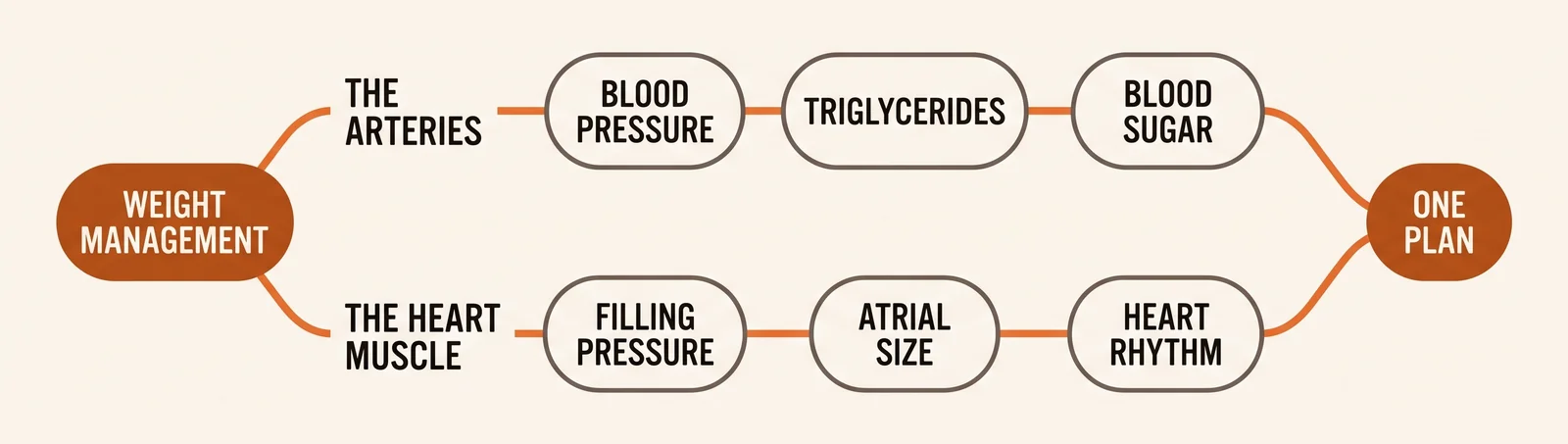
Our cardiologists prescribe GLP-1 medications, including semaglutide (Wegovy, Ozempic) and tirzepatide (Zepbound, Mounjaro), in a weight management program built to lower the risk of atherosclerosis and heart failure. Excess weight raises cardiovascular risk on two sides: in the arteries it comes with higher blood pressure, ApoB, triglycerides, and blood sugar, and in the heart muscle it adds load that stiffens the ventricle and enlarges the left atrium over years. Treatment is managed in the same plan as ApoB and Lp(a) treatment, blood pressure, coronary imaging, and follow-up of heart structure and function.
Weight management works on both sides of cardiovascular risk: the blood pressure, triglycerides, and blood sugar that drive plaque in the arteries, and the filling pressure, atrial size, and rhythm of the heart muscle. Both are followed in the same plan.
Weight affects both the arteries and the heart muscle
On the artery side, excess weight often shows up alongside several other
risk factors at the same time: blood pressure that's a little higher than
it was a few years ago, higher ApoB and triglycerides, and a hemoglobin A1c
approaching the diabetes range. A family history of early heart disease or
a coronary calcium score above zero makes each of them more important to
treat.
Weight fell 14 kg (13%) over 50 weeks on semaglutide titrated to 2.4 mg weekly. On echocardiography, the E/e' ratio, an estimate of left ventricular filling pressure, fell. Left atrial volume index, a measure of left atrial size, rose from 33 to 36 mL/m² in the year before treatment and was 35 mL/m² on the latest echocardiogram. Without treatment it would be expected to keep rising, as it did in the placebo group of the STEP-HFpEF trial. Holding steady is therefore a favorable result, since continued left atrial enlargement is associated with atrial fibrillation and heart failure. Systolic blood pressure fell enough to reduce amlodipine from 10 mg to 5 mg, and triglycerides and HbA1c improved. ApoB fell modestly and remains above goal on rosuvastatin, so additional lipid-lowering therapy is under consideration. Lp(a) was unchanged, as expected for a genetically determined value.
weight Body Composition
94 kg
systolic BP Blood Pressure
126 mmHg
optimal <120
E/e' ratio (average) Diastolic Function
11.7
ref <14
left atrial volume index Left Atrium
35 mL/m²
ref <34
triglycerides Triglyceride Metabolism
166 mg/dL
ref <150
HbA1c Glycemic Control
5.6 %
ref <5.7
ApoB Atherogenic Burden
84 mg/dL
optimal <80
Lp(a) Lipoprotein A · modifier
147 nmol/L
ref <75
Expected changes with weight reduction
Weight falls at least 10% within a year on semaglutide 2.4 mg — read from weight
Left atrial enlargement stops and E/e' improves as weight falls — read from left atrial volume index, E/e' ratio (average)
Blood pressure, triglycerides and HbA1c improve as weight falls, so blood pressure medication may need to come down — read from systolic BP, triglycerides, HbA1c
ApoB changes little with weight loss and still depends on lipid-lowering therapy — read from ApoB
Example view. Synthetic patient and synthetic values — not a real
person, and not medical advice.
Weight also adds load to the heart muscle, and over years that load
stiffens the ventricle and enlarges the left atrium, which is the path
toward atrial fibrillation and heart failure with preserved ejection
fraction. That side of the heart is measured with an echocardiogram, which
the other half of your
heart describes in detail.
Weight loss lowers blood pressure, triglycerides, and blood sugar and takes
load off the heart muscle, so managing weight as part of cardiovascular
prevention puts both sides in the same plan as ApoB, Lp(a), blood pressure,
and coronary imaging.
Semaglutide and tirzepatide produce large, sustained weight loss
In STEP 1,
1,961 adults without diabetes and with a body-mass index of 30 or higher
(27 or higher with a weight-related condition) took weekly semaglutide
2.4 mg or placebo alongside lifestyle intervention. At 68 weeks, body
weight had fallen 14.9% on semaglutide and 2.4% on placebo (difference
12.4 percentage points, 95% CI 11.5 to 13.4), with greater improvement
in cardiometabolic risk factors on semaglutide.
SURMOUNT-1
tested tirzepatide in 2,539 adults without diabetes under the same
body-mass index criteria. At 72 weeks, weight had fallen 15.0%, 19.5%,
and 20.9% on the 5, 10, and 15 mg doses, against 3.1% on placebo, and
every prespecified cardiometabolic measure improved with tirzepatide.
Semaglutide lowers major cardiac events
The clearest outcome evidence comes from the
SELECT
trial. It enrolled 17,604 people aged 45 or older with established
cardiovascular disease and a body-mass index of 27 or higher, none of
whom had diabetes, and randomized them to weekly semaglutide 2.4 mg or
placebo. Over a mean follow-up of 39.8 months, cardiovascular death,
heart attack, or stroke occurred in 6.5% of the semaglutide group and
8.0% of the placebo group (hazard ratio 0.80, 95% CI 0.72 to 0.90).
That's about one major cardiac event prevented for every 67 people
treated for a little over three years. Because none of the participants
had diabetes, the result applies directly to people who don't have it.
SELECT enrolled only people who already had cardiovascular disease.
SURMOUNT-MMO,
an outcome trial of tirzepatide that also enrolls people with
cardiovascular risk factors but no established cardiovascular disease,
is expected to finish in late 2027. Until those results are available,
treatment in people without established disease is based on the
improvements in blood pressure, triglycerides, and blood sugar that
weight loss produces.
Weight raises atrial fibrillation and heart failure risk
Obesity is a risk factor for atrial fibrillation and increases the risk
of heart failure with preserved ejection fraction. Trials in people who
already have these conditions show that both respond to treatment aimed
at weight. In a
2013 randomized
trial in overweight and obese patients with atrial fibrillation,
structured weight loss (14.3 kg against 3.6 kg) reduced AF symptom burden
and the frequency and total duration of episodes. In the
SUMMIT
trial of heart failure with preserved ejection fraction and obesity,
tirzepatide lowered cardiovascular death or worsening heart failure from
15.3% to 9.9% over a median of two years (hazard ratio 0.62, 95% CI 0.41
to 0.95), driven by fewer worsening heart failure events.
In the
echocardiography
substudy of STEP-HFpEF, which measured the heart muscle's response
directly, 491 participants with obesity-related heart failure with
preserved ejection fraction had an echocardiogram at randomization and
after 52 weeks. Left atrial volume rose by 6.89 mL on semaglutide and by
13.02 mL on placebo (difference −6.13 mL, 95% CI −9.85 to −2.41). The
average E/e′ ratio, an estimate of filling pressure, fell by 0.79 relative
to placebo, a borderline difference (95% CI −1.60 to 0.01), and ejection
fraction and global longitudinal strain didn't change. The participants
already had heart failure, so the result shows that atrial enlargement in
obesity-related heart disease can be slowed, in a population further along
than a prevention patient. The example record above
follows left atrial size and the E/e′ ratio as its heart-muscle readouts,
next to weight, blood pressure, and the lipid panel.
Treatment runs alongside lipid and blood pressure care
Weight reduction changes the rest of a prevention plan, and those changes
are made at the same visits:
Blood pressure. Blood pressure often falls as weight
comes down, and antihypertensive doses may need to come down with it.
Home readings guide those changes.
Lipids. LDL cholesterol falls only modestly with
weight loss, and Lp(a) doesn't change. When ApoB needs to go lower,
statins, ezetimibe, and PCSK9 inhibitors are still used. See
advanced lipid management.
Coronary calcium and plaque. A calcium score above
zero or plaque on a CT coronary angiogram sets how intensively ApoB is
treated, independent of weight change. See
which heart test, when.
Blood sugar. Hemoglobin A1c is rechecked as weight
comes down, and any diabetes medication that can cause low blood sugar
is coordinated with whoever prescribes it.
Procedures and surgery. GLP-1-based medications slow
stomach emptying, which matters for anesthesia, so the plan around a
scheduled procedure is set in advance. See
pre-surgery cardiac clearance.
Side effects and dose escalation
Doses start low and increase in steps over several months, mainly to
keep nausea, vomiting, diarrhea, and constipation manageable. In STEP 1,
nausea and diarrhea were the most common side effects of semaglutide,
typically transient and mild to moderate, and 4.5% stopped because of
gastrointestinal effects against 0.8% on placebo. In SURMOUNT-1,
gastrointestinal effects were the most common with tirzepatide, mostly
mild to moderate and concentrated in the dose-escalation period, and
between 4.3% and 7.1% stopped because of adverse events, depending on
dose, against 2.6% on placebo. Follow-up during escalation reviews side
effects alongside weight, blood pressure, and the rest of the medication
list.
Managing cardiac weight treatment by video
First visit by video. Cardiac and family history,
current medications, weight history, and a review of prior labs and
imaging.
Baseline testing near home. A lipid panel with ApoB
and Lp(a), hemoglobin A1c, kidney function with a urine
albumin-to-creatinine ratio, and a coronary calcium score when it would
change the plan. Labs are drawn at a local Quest or LabCorp.
Prescription and dose escalation. The prescription
goes to your pharmacy. Follow-up visits during escalation review side
effects, weight, blood pressure, and the rest of your
medications.
Follow-up every 3 to 6 months once the dose is
stable, with repeat labs, and a visit note to your primary care
physician after each visit.
Frequently Asked Questions
Common questions
Can a cardiologist prescribe weight loss medication?
Yes, GLP-1-based medications such as semaglutide and tirzepatide can be prescribed by any physician licensed to prescribe. Our cardiologists prescribe them as part of cardiovascular prevention and manage them alongside lipid and blood pressure treatment, so changes elsewhere in the regimen happen at the same visits.
Does losing weight reduce heart attack risk?
The strongest evidence is from the SELECT trial, in people who already had cardiovascular disease, where semaglutide lowered the rate of cardiovascular death, heart attack, or stroke from 8.0% to 6.5% over a mean of about 3.3 years. SURMOUNT-MMO, an outcome trial of tirzepatide that also enrolls people who don't have established cardiovascular disease, is expected to finish in late 2027. Until those results are available, treatment for people who don't have established disease is based on the improvements in blood pressure, triglycerides, and blood sugar that weight loss produces.
Does losing weight lower cholesterol?
Weight loss lowers some lipid values more than others. Triglycerides usually fall substantially, LDL cholesterol falls modestly, and Lp(a) doesn't change because it's genetically determined. Many people still need a statin, ezetimibe, or a PCSK9 inhibitor to bring ApoB and LDL to target, and that's managed in the same plan as the weight treatment.
Is Wegovy used for heart disease prevention?
Wegovy is semaglutide at a weekly dose of 2.4 mg. Its cardiovascular outcome evidence comes from the SELECT trial, which enrolled 17,604 people aged 45 or older with established cardiovascular disease and a body-mass index of 27 or higher, none of whom had diabetes. In that trial it lowered the rate of cardiovascular death, heart attack, or stroke from 8.0% to 6.5%. In people without established cardiovascular disease, it's prescribed for its effects on weight, blood pressure, triglycerides, and blood sugar.