


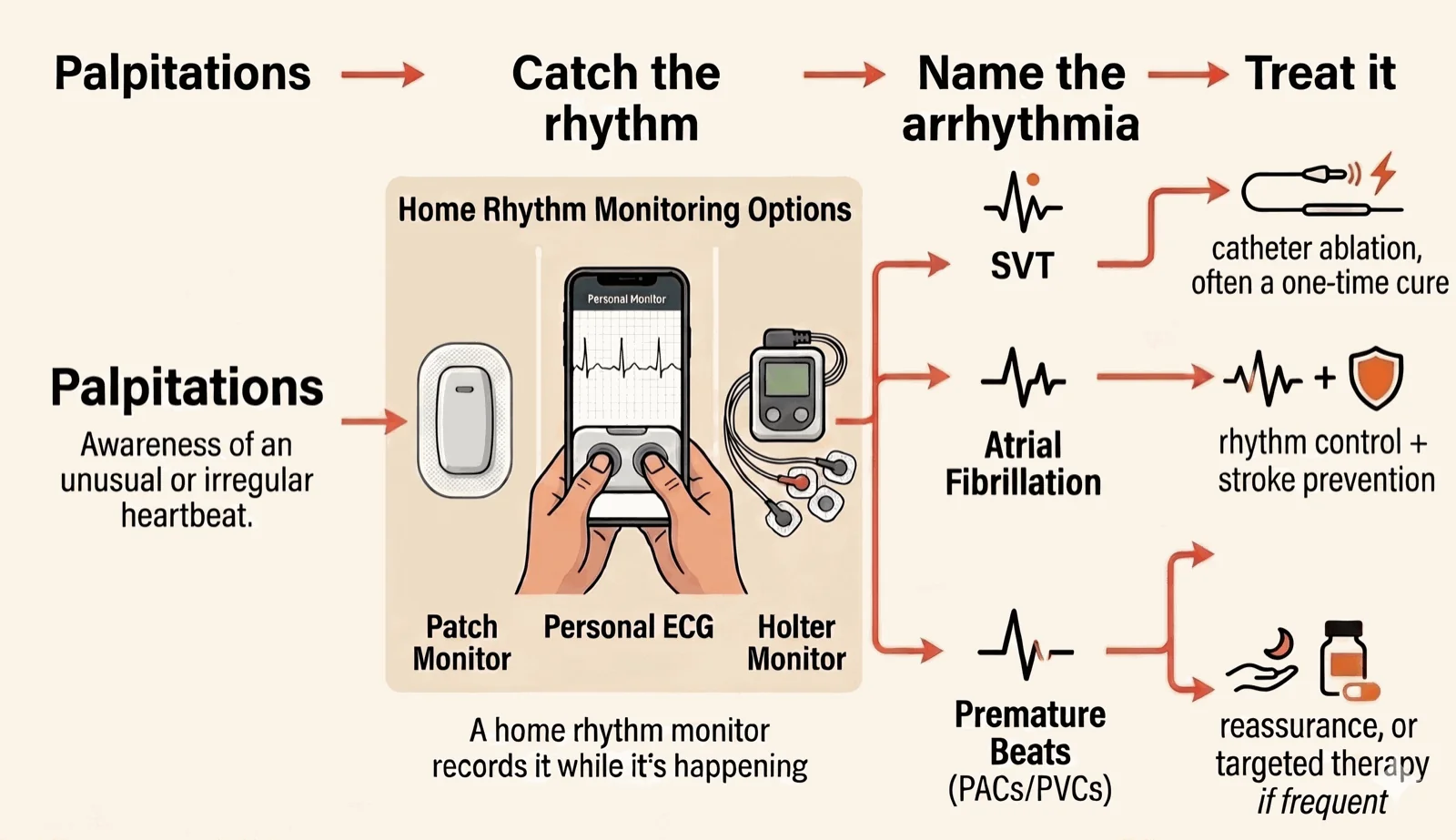
The many faces of palpitations
Different people describe palpitations differently — and the description itself is one of the most useful clues we have. Common descriptions include:
- Racing — a fast, sustained heartbeat, often out of proportion to what you are doing.
- Pounding — a forceful heartbeat that you feel in your chest, neck, or even your head.
- Flip-flop or "skipped beat" — a single extra-strong beat after a pause, usually a premature beat (PVC or PAC) being noticed.
- Fluttering — a rapid, fluttery sensation, sometimes irregular.
Each of these patterns points toward different rhythms — racing that starts and stops abruptly suggests a supraventricular tachycardia (SVT); an irregular flutter raises atrial fibrillation; isolated skipped beats are usually premature beats; pounding without a fast rate often turns out to be a normal heart simply being noticed in a stressed or anxious moment.
Common causes and triggers
Most palpitations come from one of a small number of buckets:
- Premature beats (PACs, PVCs). Extremely common, usually harmless, often noticed more when you are quiet (lying down at night, sitting still).
- Supraventricular tachycardia (SVT). A sudden onset of a fast, regular heartbeat that stops just as suddenly. Treatable, often curable with a one-time procedure.
- Atrial fibrillation. An irregular, often-fast heartbeat. Common over age 60. Worth identifying because it carries a stroke risk that is highly reducible with modern therapy.
- Stimulant or medication triggers. Caffeine, alcohol, nicotine, decongestants, ADHD medications, some thyroid medications, weight-loss compounds, and certain supplements all show up here.
- Thyroid problems. An overactive thyroid is a common reversible cause and should be checked at the first visit.
- Anxiety and stress. A real biological cause of a real symptom — the heart is responding to the same surge of adrenaline that drives the rest of the anxiety response.
Palpitations worth a closer look
A few patterns elevate priority — not because they are common, but because they are the ones we want to be sure about:
- Palpitations with chest pain, severe breathlessness, or fainting.
- Palpitations brought on by exertion (rather than relieved by it).
- A family history of sudden cardiac death or unexplained drowning / motor-vehicle accidents.
- Known heart disease — prior infarction, heart failure, hypertrophic cardiomyopathy, congenital heart disease.
If any of these apply, a cardiology visit moves higher on the priority list. If none apply, the workup is still worth doing — but with the expectation that we are almost certainly going to find something benign.
Working up palpitations by video
The diagnostic logic is well suited to a virtual visit:
- Detailed history — Your cardiologist will ask exactly what the sensations feel like, when they happen, how long they last, what triggers them, what stops them, and what associated symptoms are there. This is where most of the differential diagnosis is generated.
- Review of any rhythm tracings you have — including smartwatch ECG snapshots from the moment of symptoms. Send any tracings ahead of the visit; an iPhone screenshot or PDF works.
- Targeted testing — labs (thyroid, electrolytes, basic CBC) drawn at a lab close to your home; an ECG done in a local lab or via patch monitor; a rhythm monitor ordered to your home if symptoms are frequent enough to be captured.
- Echocardiogram if indicated — to check the heart's structure. Scheduled at an imaging center near you; Your cardiologist reviews the report after.
- Plan and follow-up — most patients get a clear answer and a plan in one or two visits. Treatment varies with the diagnosis: reassurance and trigger management for benign palpitations; medication for symptomatic SVT or AFib; ablation referral when curative.
Almost always benign — still worth an answer
Palpitations are common, scary in the moment, and almost always benign — but they are worth evaluating because (a) the diagnostic tools are excellent, (b) the small number of patterns that matter are identifiable, and (c) effective treatments exist for the ones that do need treatment. A virtual cardiology visit is an efficient way to get to an answer without the wait for an in-person cardiology slot.