

How does virtual cardiology work?
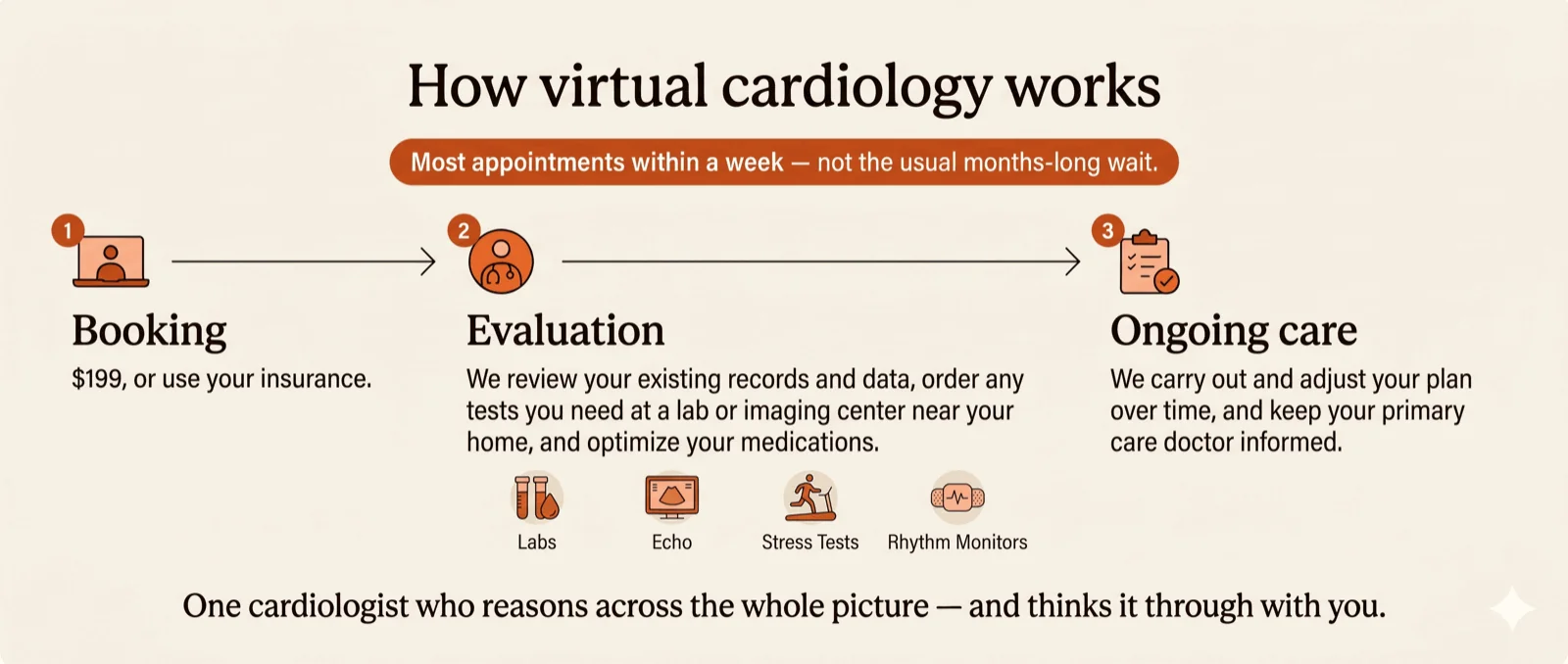
There's a shortage of cardiologists. In most cities the wait to be seen as a new patient runs 3–6 months — and routine follow-ups for medication management lag too, leaving people with poorly managed blood pressure or cholesterol, or not on the right heart-failure medications. In some parts of the country it can approach a year.
Almost all cardiology care — short of a procedure — can be delivered well by video. We take a detailed history, review your prior records and test results, and order any testing you need. Visits are efficient, without the drive, parking, or waiting room. Once results are in, we review them with you, start or adjust your medications, and decide on next steps together — and a copy of the plan goes to your primary care doctor.
Conditions we manage
Most of what brings people to a cardiologist fits the virtual model: cholesterol and prevention, high blood pressure, palpitations and atrial fibrillation, heart failure, valve and structural questions, fainting and abnormal-ECG workups, second opinions, and pre-operative clearance. Our focus areas have a detailed page on each. The few things that truly need to be in person — a procedure or a hands-on exam — we identify early and coordinate with a cardiologist near you.
Testing, done near you
We order and interpret the full range of cardiac tests — labs (including Lp(a) and ApoB), stress tests, echocardiograms, Holter and patch monitors, coronary calcium scores, and CT angiography (including Cleerly). The test is done at a lab or imaging center near your home; the results come back to us, and we walk through them with you. No more multi-month wait for an in-person slot just to get an order written.