

Fatty acids and the heart: beyond the omega-3 index
A patient joins a video visit with a fatty acid panel on the screen: a Boston Heart report, an OmegaQuant Omega-3 Index, or the fatty acid section of a Function Health workup, ordered by a functional medicine practice, a longevity program, or bought directly. There are twenty-odd values, each flagged green, yellow, or red: an omega-3 index, an EPA level, a DHA level, an AA/EPA ratio, a saturated fatty acid index, a trans fatty acid index. The patient wants to know two things. Is my fatty acid profile a problem, and if I change it, will my heart be better off. Those are not the same question, and the distance between them is the whole story.
Reading the panel
The panel sorts a few dozen individual fatty acids into a handful of indices. A saturated fatty acid index (myristic, palmitic, stearic). A trans fatty acid index. A monounsaturated index (oleic, palmitoleic). And the part everyone came for: the omega-3s. Omega-3 and omega-6 are the two families of polyunsaturated fat, named for a difference in their structure; the omega-3s are concentrated in oily fish, the omega-6s come mostly from vegetable oils and processed food. The two omega-3s that matter for the heart are eicosapentaenoic acid (EPA) and docosahexaenoic acid (DHA), usually reported together as an omega-3 index and shown next to a couple of ratios: EPA to arachidonic acid (AA, the main omega-6), and total omega-6 to omega-3. What those ratios add is a question for later.
Two wrinkles matter before you read a single number. First, the long-chain omega-3s are not interchangeable, and most panels report three of them, not two. EPA incorporates into cell and mitochondrial membranes and into LDL and HDL particles, where it slows oxidation of the lipids that destabilize a plaque; DHA is taken up into heart muscle and vascular cell membranes as well, where it increases membrane fluidity (reviewed in Mason and colleagues, ATVB 2020). That is mechanism, not proven clinical benefit. The third is docosapentaenoic acid (DPA), which the body makes by elongating EPA and which sits chemically between EPA and DHA. It appears on the panel, since Quest's OmegaCheck value is EPA plus DPA plus DHA, and it carries an association of its own that the EPA-versus-DHA argument tends to ignore. A drug that raises one will not necessarily raise the others: icosapent ethyl, the prescription omega-3, is purified EPA and cannot lift your DHA at all. If DHA is your low number, more of that drug will not fix it.
Second, the omega-3 index is one number with more than one definition. OmegaQuant measures it in red blood cell membranes, as EPA plus DHA expressed as a percentage of all the fatty acids there, and calls 8 to 12 percent desirable. Boston Heart's fatty acid index uses a different assay on a different scale, and calls anything above 4.5 percent optimal. The two may well rank people much the same way; a different scale is not evidence of different biology. What you cannot do is carry an absolute value, or a target, from one to the other. So pick one assay and stay with it, and your trend over time means something. Compare across vendors and part of what you are seeing is which lab drew the blood.
The association is strong, and it is specific
Before the data, a word on how to read it. Whether two studies are answering the same question comes down to four things: what was given (which molecule, at what dose), to whom, for how long, and what was counted as an event. Change any one of them and you have a different experiment, not a replication, and two results that look contradictory may simply be answers to two different questions. This is also the quickest way to spot weak science: vary the intervention, change the endpoint, and present the result as a replication. Most of the confusion about fish oil dissolves once those four are held in view.
The reason anyone measures blood omega-3 at all is a large and consistent body of observational data. The omega-3 index was proposed in 2004 as a marker for one specific outcome: dying of coronary heart disease, and sudden cardiac death in particular. A red-cell EPA-plus-DHA above 8 percent marked the lowest risk, below 4 percent the highest ( Harris and von Schacky, Prev Med 2004). Note which measurement that is: the 8 percent figure belongs to the red-cell index, the assay OmegaQuant reports. It is not a threshold you can carry across to Boston Heart's fatty acid index, which is scaled differently and calls 4.5 percent optimal.
The largest test of that idea pooled 19 cohorts and 45,637 people ( Del Gobbo and colleagues, JAMA Intern Med 2016), and it is worth being exact about what it counted. The endpoint was fatal coronary heart disease, counted as one of three things: a fatal myocardial infarction, a sudden cardiac death, or another death attributed to coronary disease where no acute infarction was documented. Two of those deserve a caveat. Sudden cardiac death was counted as coronary without requiring proof that it was, and sudden death also arises from cardiomyopathy, primary arrhythmias, and valve disease; coronary disease is simply the commonest cause at these ages. The third category is the least crisply defined, and each cohort ascertained it in its own way. Softer non-fatal events such as angina and revascularization were deliberately excluded. Per one standard deviation higher blood level, the risk of that endpoint was about 9 percent lower for every one of them: EPA 0.91 (95% confidence interval 0.82 to 1.00), DPA 0.90 (0.85 to 0.96), DHA 0.90 (0.84 to 0.96), and the plant omega-3 alpha-linolenic acid (ALA) 0.91 (0.84 to 0.98). EPA plus DPA plus DHA taken together was associated with an 11 percent lower risk. EPA's interval just touches 1.00, so some summaries file it as the one that failed; its effect size is the same as the others, and the difference is statistical luck rather than biology.
The sharper contrast is not between the molecules but between the endpoints: in the same analysis, none of the long-chain omega-3s was significantly associated with nonfatal myocardial infarction. So the values on your report track with dying of coronary disease, not with having a heart attack and surviving one, a far narrower claim than fish-oil marketing usually makes, and the one the observational evidence actually supports.
That split is also a clue about mechanism, and it points more toward electrical stability than toward plaque. A fatty acid that made plaque less likely to rupture should prevent nonfatal infarctions too, and this data does not show that. A fatty acid that made a heart less likely to fibrillate in the minutes after an ischemic insult would show up exactly here: fewer deaths, with the infarctions themselves unchanged. Both mechanisms have laboratory support and the observational data does not force a choice between them. One finding fits neither story cleanly: in the trials, high doses of omega-3 consistently increased atrial fibrillation. Protective in the ventricle, provocative in the atrium, and so far unexplained.
The ceiling on all of this is the word association. People with high blood omega-3 eat more fish, and they also tend to be leaner, wealthier, less likely to smoke, and more engaged with their health. Cohort studies adjust for what they can measure and cannot adjust for what they cannot. The only way to learn whether raising your level changes your outcome is to raise it deliberately and watch.
Moving the number is the easy part
The epidemiology invites an obvious question that it never answers: if a higher blood level goes with a lower risk, what would it actually take to get there?
For the omega-3 index, not much. In the original dose-ranging work, five months of half a gram a day of EPA plus DHA took the red-cell index from about 4.7 percent to 7.9 percent; a gram a day reached 9.9 percent, and two grams 11.6 percent. Read those upper numbers with care, because the groups were tiny, nine people and four, and everyone in the study had been told to avoid oily fish, which likely flatters the response. But the direction is not in question: an ordinary dose moves this number by several times its own variability. Food lands in the same territory. The equivalent of 40 to 60 g of fish a day supplies roughly 0.2 to 1.0 g of n-3 fatty acids.
That matters more than it sounds, because plenty of nutrition findings die on exactly this question. If the only way to reach the levels seen in the observational data were a dose nobody could eat, the association would be a curiosity rather than something to act on. Omega-3 passes that test, which is the main reason the question stays open at all.
One dose does not pass it. The 3.8 g of EPA a day used in the largest positive trial is many times what a standard fish-oil capsule delivers, and it is not reachable by eating fish. That is a prescription drug, not a diet. When a trial of that dose is used to sell a supplement, or a salmon fillet, two very different exposures are being presented as one.
One practical note if you do change something: the index reflects roughly the previous four months of intake, in the way HbA1c reflects the previous few months of glucose. Recheck at three to four months, not three weeks.
The supplement trials, and why they don't close the question
That has been done, many times. Three trials carry most of the weight, and they are worth setting side by side rather than summarizing as "the fish oil trials."
| Trial | Given daily | Who | For how long | What was counted | Result |
|---|---|---|---|---|---|
| VITAL | 840 mg n-3 (460 mg EPA + 380 mg DHA) | 25,871 US adults with no known heart disease (men 50+, women 55+) | median 5.3 years | heart attack, stroke, or cardiovascular death | 0.92 (0.80–1.06) |
| ASCEND | 1 g of n-3 fatty acids | 15,480 adults with diabetes and no known heart disease | mean 7.4 years | nonfatal heart attack or stroke, transient ischemic attack, or vascular death | 0.97 (0.87–1.08) |
| OMEMI | 1.8 g n-3 (930 mg EPA + 660 mg DHA) | 1,027 adults aged 70 to 82, two to eight weeks after a heart attack | 2 years | heart attack, unscheduled revascularization, stroke, death from any cause, or heart-failure hospitalization | 1.08 (0.82–1.41) |
The comparators differed as well: a matching placebo in VITAL, olive oil in ASCEND, corn oil in OMEMI.
Three null results, with no benefit to translate into a number needed to treat. But look at what varies down those columns. The dose more than doubles. One trial enrolled healthy volunteers, one people with diabetes, one people recovering from a heart attack. Follow-up runs from two years to seven. And each trial counted a different set of events. These are not three attempts at the same experiment, and treating them as replications of one another is exactly the move worth distrusting.
The endpoint column matters most. The observational signal was on fatal coronary disease, and specifically not on nonfatal infarction. Each of these trials made a composite its primary outcome, and in each the nonfatal events dominate the count; OMEMI's composite folds in unscheduled revascularization and heart-failure admissions too. A trial can be flawlessly run and still count mostly the events where the epidemiology never promised anything.
Dose deserves more care than it usually gets. It is tempting to dismiss these trials as underdosed, but 840 mg a day is not a token exposure: in the original dose-ranging work, half a gram a day raised the red-cell omega-3 index from about 4.7 to 7.9 percent. These trials very likely did move blood levels. What they did not do was measure or target them. Individual response to a fixed dose varies substantially, so a trial that assigns capsules rather than achieving a level is asking a slightly different question than the cohorts asked. The closest thing to a direct test points the right way, imperfectly: in a substudy of the Japanese EPA trial, patients who actually reached a blood EPA above 150 µg/mL had fewer coronary events, and the trial that drove EPA highest, 3.8 g a day reaching about 144 µg/mL, is the one that clearly worked. Those are within-trial associations rather than clean experiments, since people who reach high levels may differ from those who do not.
The meta-analysis usually offered as the closing argument rewards a close look at what it counted. Across eighteen randomized trials, EPA plus DHA produced no significant reduction in "any CHD event": 0.94 (0.85 to 1.05) ( Alexander and colleagues, Mayo Clin Proc 2017). But that endpoint is a composite of fatal and nonfatal myocardial infarction, coronary death, sudden cardiac death, and angina. Angina is in there. The headline number averages deaths together with chest pain.
Ask the same eighteen trials about coronary death by itself and the answer changes: 0.81 (0.65 to 1.00), and 0.80 (0.64 to 0.99) among the secondary-prevention trials. That is the same shape the cohort data showed, a signal on dying rather than on softer events, arrived at by an entirely different route. It is also a measure of how much work the choice of endpoint is doing inside the sentence "the fish oil trials were negative."
The risk strata are where it gets uncomfortable. Benefit appeared in participants with triglycerides at or above 150 mg/dL (0.84; 0.72 to 0.98) and LDL at or above 130 mg/dL (0.86; 0.76 to 0.98), and more strongly at doses above 1 g/d in the high-triglyceride group (0.75; 0.64 to 0.89). Below those thresholds the estimates were 1.04 (0.96 to 1.13) and 1.03 (0.95 to 1.12). Note what that is and is not: not the same estimate with wider intervals, which is what you would see if only the number of events had changed, but point estimates that move in the opposite direction. Neither crosses into significance, and neither points toward benefit. An overall figure of 0.94 is the average of those two stories.
Both readings deserve airing. The skeptical one is that this is what subgroup analysis looks like when it is noise, and that slicing a null result until something clears significance is a well-worn way of finding things that are not there. The charitable one is that it is real, in which case the caution runs in the same direction, because a low-risk person would be getting nothing while still carrying the atrial fibrillation risk that comes with higher doses.
Underneath both sits a point that holds even if the relative effect were identical in everyone. Apply the same percentage reduction to a larger baseline risk and you prevent more events, and you treat fewer people to prevent one. A therapy can be worth taking with established disease and high triglycerides and not worth taking at fifty and healthy, with no difference in the biology at all. It is why trials in this area recruit high-risk patients already on statins rather than volunteers.
The same paper's separate pooling of sixteen cohort studies found 0.82 (0.74 to 0.92), which sounds like more evidence for taking a supplement and is not. Those studies compared people by how much EPA and DHA they consumed rather than assigning it, so they belong with the observational evidence above and inherit its confounding rather than resolving it.
For a reader holding a bottle, the practical translation is narrow but real: at these doses, roughly what one standard fish-oil capsule provides, no one has shown a reduction in cardiovascular events in a general population. That is a finding about that dose, in those people, counted that way. It is not a finding that omega-3 status does not matter.
Then there is the clock. Atherosclerosis is a disease of decades, and the LDL literature established that the benefit of lowering an atherogenic exposure scales with how long you lower it, not only how far. A five-year trial in seventy-year-olds tells you very little about what four decades of adequate omega-3 status does to a forty-year-old's lifetime risk, and no one is going to run that trial. A placebo-controlled study spanning forty years of primary prevention does not exist and never will. The absence of that evidence is a fact about what medicine can feasibly study, not a fact about the biology.
The high-dose divergence: REDUCE-IT and STRENGTH
At high doses the picture changes, and then immediately becomes confusing.
| Trial | Given daily | Who | For how long | What was counted | Result |
|---|---|---|---|---|---|
| REDUCE-IT | 4 g icosapent ethyl (about 3.8 g purified EPA) | 8,179 statin-treated adults, triglycerides 135–499 mg/dL; 71% with established cardiovascular disease | median 4.9 years | cardiovascular death, nonfatal heart attack, nonfatal stroke, coronary revascularization, or unstable angina | 0.75 (0.68–0.83) |
| STRENGTH | 4 g omega-3 carboxylic acid (about 2.2 g EPA + 0.8 g DHA) | 13,078 statin-treated adults at high risk, triglycerides 180–500 mg/dL with low HDL; 70% with diabetes | halted early for futility, at 1,384 of a planned 1,600 events | the same five-part composite | 0.99 (0.90–1.09) |
| JELIS | 1.8 g EPA added to a statin | 18,645 Japanese adults with high cholesterol | mean 4.6 years | sudden cardiac death, fatal or nonfatal heart attack, unstable angina, angioplasty, stenting, or bypass | 0.81 (0.69–0.95) |
The comparators differ again, and here it matters more than anything else in the table: mineral oil in REDUCE-IT, corn oil in STRENGTH, and in JELIS no placebo at all, since the control group simply took their statin and the trial was open-label.
Take REDUCE-IT on its own terms first, because the effect is not small. The primary endpoint fell from 22.0 percent to 17.2 percent over a median 4.9 years: 4.8 percentage points in absolute terms, or roughly one event prevented for every 21 people treated for five years. That is drug-sized, in the range statins deliver in secondary prevention.
Then look at what was counted. The primary endpoint is a five-part composite, and two of its components, coronary revascularization and unstable angina, are decisions made by physicians rather than events that simply happen. The result does not rest on them, though: the harder three-part endpoint of cardiovascular death, heart attack and stroke moved almost identically, 0.74 (0.65 to 0.83), and cardiovascular death by itself fell to 0.80 (0.66 to 0.98). JELIS is the instructive contrast. Its 19 percent reduction was carried by unstable angina, down 28 percent, while the hard endpoints, coronary death and fatal or nonfatal heart attack, did not reach significance. Two positive trials, and only one of them positive on the endpoints that cannot be argued with.
STRENGTH then gave a nearly identical daily dose, to a similar high-risk statin-treated population, measured against the same five-part composite, and found nothing at all.
Two explanations are live. The first is the molecule: REDUCE-IT and JELIS used purified EPA while STRENGTH used EPA combined with DHA, and the achieved blood levels followed, roughly 144 µg/mL of EPA in REDUCE-IT against 89.6 in STRENGTH. The second is the comparator. A biomarker substudy of REDUCE-IT found the mineral-oil arm drifting the wrong way over the trial: by study end, relative to the treatment arm, LDL cholesterol was 10.9 percent higher, hs-CRP 38.5 percent higher, interleukin-1β 48.7 percent higher, and Lp-PLA2 26.2 percent higher ( Ridker and colleagues, Circulation 2022). If the comparator arm was made worse, part of that 25 percent belongs to the mineral oil rather than to the EPA.
The usual reply is that the benefit held across triglyceride levels. That answers a different question than the one being asked. Consistency across triglyceride strata bears on whether triglyceride-lowering mediated the effect, and argues that it did not. It says nothing about whether the mineral oil confounded the comparison. Those are separate problems, and the second is untouched by the first. The stronger reply is about magnitude: percentage shifts in an inflammatory marker can look alarming while remaining too small in absolute terms to manufacture a 4.8-point difference in events. That argument is reasonable, and it has not been settled.
So the most impressive omega-3 trial in existence is also the one we are least able to interpret. High-dose purified EPA, in high-risk statin-treated patients with elevated triglycerides, is neither established nor refuted. And it is worth saying plainly what this section is not about: 3.8 grams of EPA is a prescription drug given to people with established disease. Nothing here describes what happens when a healthy person takes a fish-oil capsule.
Why the genetics don't settle it
When trials are ambiguous, cardiology often turns to Mendelian randomization, using inherited gene variants as a natural experiment, since the genes you are born with cannot be confounded by diet or income or expectation. It is the tool that made the case for LDL airtight. It does not do the same work here, and it is worth understanding why.
The genetic variants available for omega-3 sit in the FADS1/FADS2 cluster, which codes for the desaturase enzymes that build long-chain fatty acids. Two large studies used them, one on aortic stenosis and one on coronary disease, and both found associations. But FADS variants are not a clean dial for "omega-3." They shift the entire desaturation cascade at once, moving omega-6 fatty acids like arachidonic acid as much as the omega-3s, changing the ratio between them, and nudging inflammatory markers along the way. They change what your body synthesizes, not what you eat. And in the aortic stenosis study the signal ran through the omega-6 arm and a heart-valve outcome, not through omega-3 and coronary plaque at all. An instrument that moves a dozen things at once and lands on the wrong endpoint cannot cleanly test whether eating more omega-3 prevents heart attacks. The genetics confirm the pathway is biologically alive; they do not referee the intervention.
How to proceed
The blood-level association is real, and it points at fatal coronary events: a fatal heart attack, a coronary death, or a sudden cardiac death, rather than the nonfatal ones. The supplement trials are less decisive than their reputation, mostly because of what they counted: composites in which nonfatal and softer events dominate, when the association was on fatal ones. Ask those same trials about coronary death and the answer shifts. They also assigned capsules rather than achieving a level, and ran for five years against a disease that takes decades. The one large positive trial is confounded by its own placebo. The genetics cannot adjudicate. This is a genuinely open question, not a settled one in either direction, and anyone who tells you fish oil is proven, or proven useless, is reading past the data.
That unsettled state is exactly where my general approach to prevention applies. If something is biologically plausible, carries little downside, and a patient wants to spend their own money on it, "it is not in the guidelines" is not a reason for me to say no. Guidelines are assembled largely from the five-year trials that, as above, are structurally blind to a thirty- or forty-year prevention question. A patient willing to act over that horizon is asking a different question than the one the guideline was built to answer.
The key words there are little downside, and with omega-3 that phrase has to be checked, not assumed. At the high doses used in the outcome trials, omega-3 carries a real and repeated signal for atrial fibrillation: 3.1 percent versus 2.1 percent in REDUCE-IT, and higher again in STRENGTH and OMEMI (7.2 versus 4.0 percent). That is not a reason to avoid it, but it is a reason not to wave four grams a day through as if it were free, especially in someone with palpitations or a prior history of AF. The low doses have not shown this. Dose cuts in both directions.
Which brings the panel back into focus and gives it the use the evidence actually supports. The strongest thread running through all of this, made explicitly in a 2013 review, is that the dose of a supplement and the level in your blood are two different things, and the level is what the biology responds to. That is precisely what the panel measures. I do not use a fatty acid panel to chase an "optimal" number for its own sake. I use it to answer concrete questions. Is a patient who already takes fish oil actually absorbing it, or is their level still low. Is the omega-3 index moving when we change something, or not. The panel earns its place as a feedback instrument, not a scoreboard.
One decision that panel often prompts deserves its reasoning spelled out, because it is easy to assert and hard to justify. If the gap is DHA rather than EPA, which is what happens on purified EPA, since that drug cannot raise DHA at all, then adding an algal DHA source is defensible. But be clear what it rests on. No trial has shown that supplementing DHA prevents cardiac events. The case is the epidemiology and the mechanism: the fatal-coronary association was not EPA-specific, with DHA at 0.90 (0.84 to 0.96), and DHA is incorporated into heart muscle and vascular membranes. Against it sits the possibility, raised by the null EPA-plus-DHA trial, that DHA offsets part of what EPA does. So it is a bet on the observational data over the trial data, taken at a modest dose where the downside is small. That is a defensible bet. It is not a demonstrated benefit, and it should not be sold as one.
DHA is also the omega-3 that dominates brain tissue, and for a good many people that, rather than the heart, is the real reason they are taking it. That is a separate body of evidence, with its own observational associations, its own null trials, and its own argument about whether those trials were built to answer the question. It deserves its own piece rather than a paragraph here.
So what does all of this add up to in practice? Something narrower than "take fish oil," and bounded at both ends.
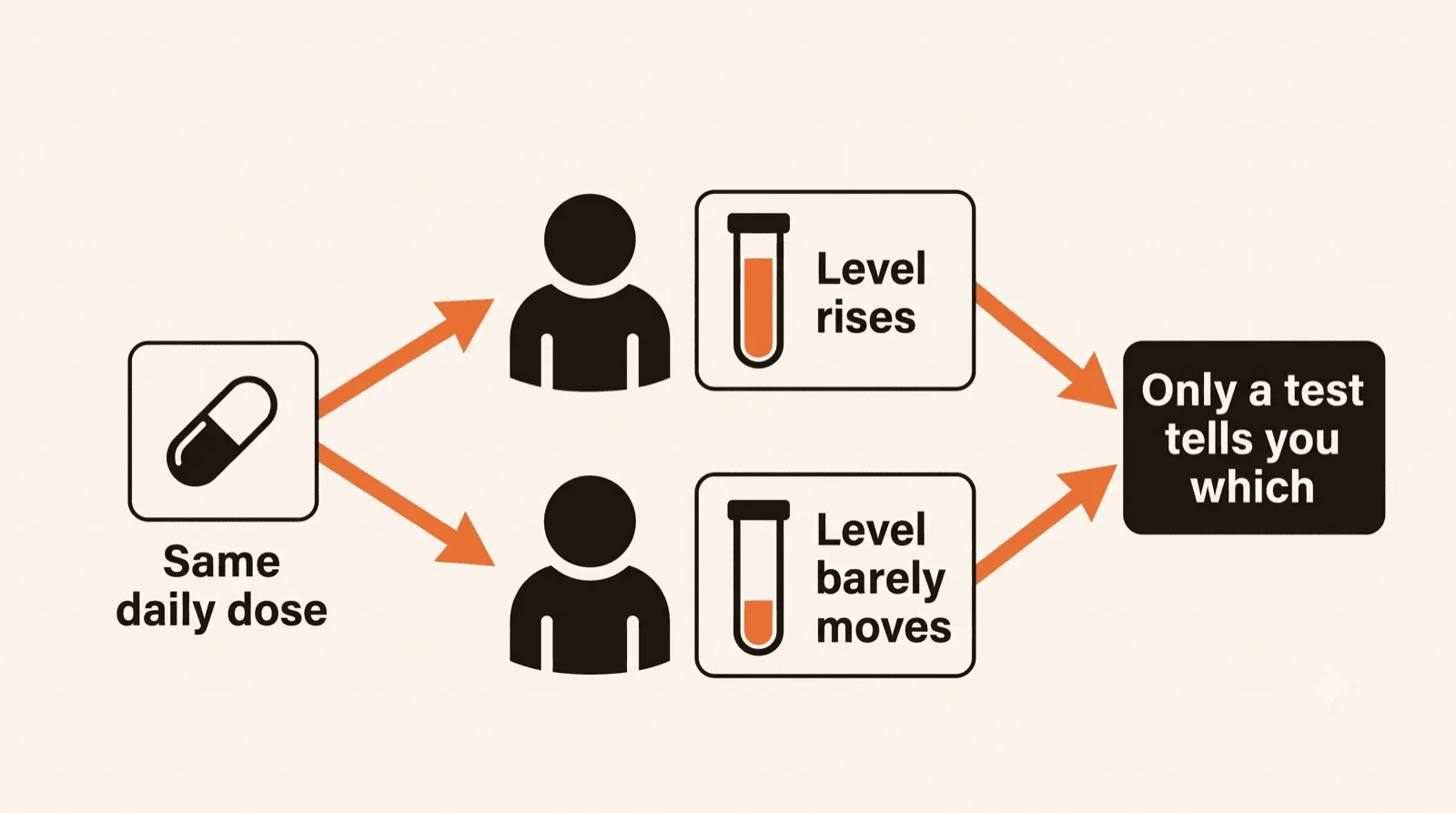
Measure before deciding anything, because the dose on the bottle does not tell you the level in your blood. If the number is already in a reasonable range, there is nothing to chase. If it is low and you want to act, change one thing, either more oily fish or a modest supplement, and recheck in three to four months, since that is the window the index reflects. If the number moved, you have learned that your regimen works, and the task becomes keeping it there rather than climbing further.
If it barely moved, the first questions are absorption and adherence rather than dose: whether it is being taken with food, whether the formulation is a reasonable one, whether it is being taken at all. A modest increase is sensible after that.
Then comes the ceiling, which is the part usually left out. Do not keep escalating toward four grams a day in order to force an index into a target range. There are three reasons. The dose with trial evidence behind it was studied as a prescription drug in a particular population, not as a method for moving a lab value. The atrial fibrillation signal appears at those doses and not at low ones. And the target has never been validated as a treatment goal: the 8 percent figure came from observing where risk was lowest among people who were already there, and no trial has randomized anyone to reach it and then counted events. Arriving at a threshold by taking capsules is not the same thing as inheriting the biology of people who sit above it without trying.
The exception is a different decision altogether and worth separating cleanly. Someone with established cardiovascular disease, or diabetes with additional risk factors, who is already on a statin and has triglycerides in the 135 to 499 range, is the population REDUCE-IT actually enrolled. For that person, high-dose prescription EPA is a clinical decision with its own indication and its own evidence, made with a cardiologist. That is a drug prescribed for a diagnosis. It is not a number being chased upward, and the two should never be run together.
For the food side of this, how the saturated and unsaturated fats you eat move your lipids, I have written separately. For the blood panel in front of you, the summary is short. The association with fatal coronary events is real and has not been explained away. Reaching the levels behind it is genuinely easy, which is what makes any of this actionable rather than academic. The trials said to have settled the question largely counted other things, and the one that clearly succeeded was a prescription drug in a defined population, measured against a comparator that may have flattered it. And nobody has shown that arriving at a target number delivers what having that number without trying appears to confer.
That leaves a decision rather than an instruction. Measure, make one modest change, measure again, and stop where the evidence stops. The bet improves the higher your own risk and worsens the lower it is, which is the reverse of how supplements are usually sold. The specific thing to watch is atrial fibrillation, which appears at high doses and not at modest ones. Inside those limits, spending your own money on a plausible, inexpensive, low-harm intervention is a reasonable thing to do, and "it is not in the guidelines" is not a good enough reason for me to talk you out of it.
Want your omega-3 index and fatty acid panel read by a cardiologist?
Book a Video Visit