
Dementia, your heart, and the APOE gene
More patients are arriving worried about dementia than about their hearts. A parent has been diagnosed, or a consumer genetic test has come back carrying an APOE4 allele, and the question lands in a cardiology visit because the cardiologist is the one managing the cholesterol and the blood pressure. The question is usually some version of this: does anything I do for my heart change what happens to my brain?
There is an answer, and it is more specific than either the reassurance or the alarm that circulates online. Part of it is settled by randomized trials. Part of it is an inference from genetics and epidemiology that is worth taking seriously without overselling. And the gene everyone is most worried about turns out to be a cholesterol-transport gene, which is why a cardiologist has anything to say about it at all.
The old fear can be set down
For a decade the loudest claim in this area ran the other way: that statins, or low cholesterol, harm the brain. In 2012 the FDA added a warning about reversible cognitive effects to statin labels, built on case reports rather than trials.
The trials have since been done. EBBINGHAUS, a cognitive substudy (EBBINGHAUS, NEJM 2017) embedded in a large trial of the PCSK9 inhibitor evolocumab, tested cognition in patients driven to very low LDL cholesterol and found no difference from placebo over a median of 19 months, meeting its threshold for no harm with high statistical confidence. Similar cognitive analyses in the large statin trials found the same. Driving LDL cholesterol down, even to levels far below what a statin alone achieves, has not produced cognitive harm in the settings where it has been measured.
There is a mechanistic reason this holds, and it turns out to be the key to everything else in this piece.
The brain keeps its own cholesterol
The brain is rich in cholesterol, and almost none of it comes from your blood.
Circulating LDL cholesterol does not cross the blood-brain barrier. The brain makes its own cholesterol in place, mostly in astrocytes, and that supply is nearly its only source (reviewed in Petrov and Pikuleva, Neurotherapeutics 2019). The pool turns over extraordinarily slowly, on the order of a five-year half-life, and the brain disposes of excess by a dedicated enzyme, CYP46A1, that converts cholesterol into a form able to leave across the barrier that cholesterol itself cannot cross.
Two consequences follow, and they organize the rest of the evidence.
First, "statins starve the brain" is wrong at the level of basic physiology. A drug that lowers cholesterol in the blood is not depleting a compartment the blood does not supply.
Second, and less obvious: if peripheral cholesterol cannot reach the brain directly, then any benefit of lowering it on dementia cannot be a direct effect on brain cells. It has to travel by another route. The most plausible route is the blood vessels. Cholesterol damages arteries, including the small arteries that feed the brain, and vascular injury is a major and often underappreciated contributor to dementia. Hold that thought, because it explains why the strongest evidence in this piece is not about cholesterol at all.
The evidence with a randomized trial behind it is blood pressure
Among everything a cardiologist manages, blood pressure control has the best evidence for protecting the brain, and it is the one place where the evidence comes from randomized trials with dementia itself as the outcome.
The strongest single result comes from rural China (He and colleagues, Nature Medicine 2025). Nearly 34,000 people with uncontrolled hypertension, spread across 326 villages, were randomized by village to either usual care or an intervention in which trained non-physician community health workers treated blood pressure to a target under 130/80. Over four years, the intervention lowered systolic pressure by 22 mmHg relative to usual care, and the primary outcome, all-cause dementia, fell by 15 percent (risk ratio 0.85, 95% confidence interval 0.76 to 0.95). Serious adverse events were lower in the treated group, not higher, so there was no safety cost to weigh against the benefit.
Two features make this result unusually solid. Dementia was the trial's primary outcome, defined in advance, not a secondary finding fished from a longer list. And the direction of every other result was consistent with benefit. The one caveat to carry is the size of the blood pressure difference. A 22 mmHg separation, achieved in people who began with uncontrolled hypertension, is large. The same 15 percent return should not be expected from tightening control in someone already near target. The number and the starting point belong together.
The American SPRINT MIND trial (Williamson and colleagues, JAMA 2019) points the same way, and its story is worth telling accurately because it is usually told loosely. SPRINT MIND randomized about 9,300 people to intensive versus standard blood pressure control and followed them for cognitive outcomes. Intensive control significantly reduced mild cognitive impairment (hazard ratio 0.81, 0.69 to 0.95) and the combined rate of mild cognitive impairment or dementia (0.85, 0.74 to 0.97). For dementia alone, the result pointed in the same direction but did not reach significance (0.83, 0.67 to 1.04). The likely reason is not that the effect was absent but that the trial stopped early once the cardiovascular benefit of intensive control became clear, leaving too few dementia cases to prove that endpoint on its own. The long-term follow-up published in 2025 shows the same pattern.
So the fair reading is that SPRINT points where the China trial proves. Taken together, two randomized trials on two continents agree that lowering blood pressure lowers the risk of cognitive decline, and one of them demonstrates it on dementia itself. Nothing else in this piece is on that footing.
Lipids: a signal to read carefully
The evidence that lowering cholesterol prevents dementia is weaker, and it is weaker in an interesting way.
There is no trial with dementia as an endpoint. What exists is genetic and epidemiological. A meta-analysis of more than a million people (Nordestgaard and colleagues, Alzheimer's & Dementia 2025) used genetic variants that mimic specific cholesterol-lowering drugs to ask whether lifelong lower cholesterol tracks with less dementia. For the mechanisms of statins, ezetimibe, and CETP inhibitors, it did, and strongly. For the mechanism of PCSK9 inhibitors, it did not reach significance, though the estimate was too imprecise to call a true difference.
The strength of those genetic associations has to be read with care, and this is where the topic most easily misleads. The genetic estimates describe the effect of a lifetime of lower cholesterol, present from birth, not the effect of starting a drug in middle age. They are best read as evidence that the direction is right, that cholesterol contributes causally to dementia risk, rather than as a promise of how much a prescription started at 55 will deliver. The translation is directional, not numerical.
The epidemiology carries a specific trap that has to be named. In midlife, higher LDL cholesterol is associated with more later dementia. A meta-analysis of more than a million UK adults found that each 1 mmol/L (39 mg/dL) higher LDL cholesterol before age 65 was associated with an 8 percent higher incidence of dementia (1.08, 1.03 to 1.14). But in late life the association reverses: low cholesterol tracks with more dementia, not less. That reversal is almost certainly not cholesterol protecting the aging brain. It is the earliest stages of neurodegeneration and frailty lowering cholesterol, years before a diagnosis. The 2024 Lancet Commission on dementia01296-0) weighed this and added high LDL cholesterol in midlife, specifically midlife, to its list of modifiable dementia risk factors.
The through-line from the biology holds here. If brain cholesterol is sealed off from the blood, the midlife LDL signal is most plausibly vascular: cholesterol injuring the vessels that supply the brain, contributing to the mixed vascular-and-Alzheimer's dementia that is far more common than pure Alzheimer's disease. That makes lipids and blood pressure two levers on the same underlying channel, which is exactly why the blood pressure evidence, acting on the same vessels with a larger effect and a cleaner trial, is the stronger of the two.
The APOE gene, which is a cholesterol gene
This is the part patients arrive already worried about, usually holding a consumer test result and no interpretation.
APOE comes in three common versions, ε2, ε3, and ε4. The ε4 allele is the strongest common genetic risk factor for late-onset Alzheimer's disease; ε2 is protective. It is also, and this is the point, a cholesterol-transport gene. APOE is the principal carrier that moves cholesterol and other lipids between cells, both in the bloodstream and, separately, inside the brain.
That dual identity produces a puzzle, and resolving it is the most useful thing this piece can offer a worried carrier.
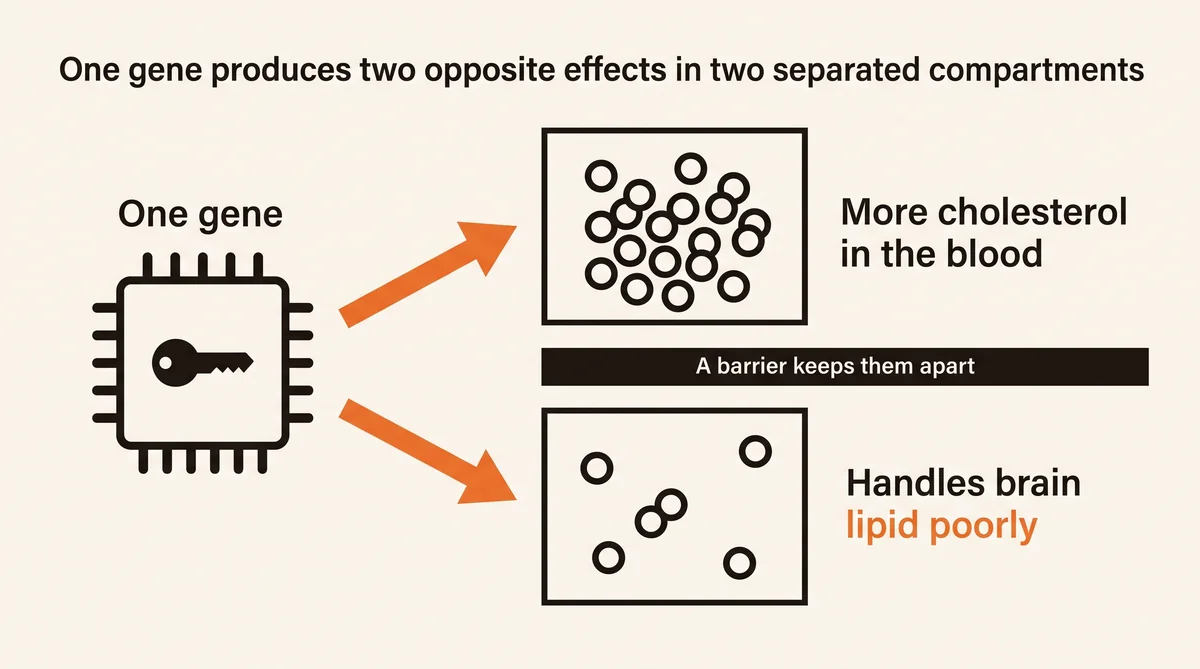
In the bloodstream, the ε4 allele raises LDL cholesterol. A large meta-analysis (Bennet and colleagues, JAMA 2007) found an approximately straight-line relationship: order the genotypes from ε2/ε2 up to ε4/ε4 and both LDL cholesterol and coronary risk rise steadily along the way. People with two ε2 alleles averaged about 44 mg/dL lower LDL cholesterol than people with two ε4 alleles, and ε2 carriers had a 20 percent lower risk of coronary disease.
Inside the brain, the same ε4 allele appears to move lipid worse, not better. In two clinical trials, after identical high doses of the omega-3 DHA, ε4 carriers raised their brain lipid markers roughly half as much as non-carriers did (Yassine and colleagues, Alzheimer's & Dementia 2020). Laboratory work points the same way, with ε4 impairing the delivery of cholesterol and lipids that brain cells depend on.
So the resolution is this. APOE4 does not raise dementia risk by flooding the brain with cholesterol. It raises risk by handling the brain's own lipid poorly, inside a compartment the blood cannot reach, while separately raising the LDL cholesterol in the blood that damages vessels. One gene, two different problems, in two compartments the blood-brain barrier keeps apart. That is why a cardiologist has a role here at all: the peripheral half of that picture is exactly what a cardiologist treats.
One caution keeps this from becoming fatalism. The link between ε4 and higher cholesterol is not universal. In a subsistence population with high infection rates, ε4 carriers showed lower inflammation and no elevation in blood lipids (Garcia and colleagues, eLife 2021). The allele's effects depend on environment, which is part of why it persisted through human evolution, and why a genotype is a probability rather than a sentence.
The DHA question, which is where this gets specific
Patients who have read about omega-3s and the brain usually arrive with a reasonable question: if DHA is the brain's structural fat, does taking it help?
The trials that tested fish oil for cognition in unselected people have largely been negative, including a large randomized trial of omega-3 supplementation that found no cognitive benefit (AREDS2, JAMA 2015). Read on their own, those trials say fish oil does not prevent dementia.
The APOE story suggests why that reading may be incomplete. If ε4 carriers raise their brain DHA levels only half as much as non-carriers at the same dose, then a trial that ignores genotype is averaging two different exposures: people whose brain DHA rises and people in whom it barely moves. The bottleneck is not the barrier, which DHA crosses; it is what the brain's own lipid-transport machinery does with it once inside, the same machinery APOE runs. A trial designed to answer whether DHA helps the people at highest genetic risk would have to select for that risk, use a higher dose, and start early, before damage accumulates. That trial is now underway (PreventE4), testing high-dose DHA in cognitively healthy APOE4 carriers, and it has not yet reported whether it works.
Which leaves DHA in the position of being mechanistically plausible, unproven in trials, and cheap and low in harm. For a worried APOE4 carrier who wants to take it, there is no good reason to argue against it, and equally no basis yet for promising it will help. What can be said is that if it works at all, it is likely a long game started in midlife, not a rescue late in the disease.
What a cardiologist can actually do
The worry about dementia is well founded and mostly outruns the medicine. But the medicine is not nothing, and it lines up in a clear order by how well it is proven.
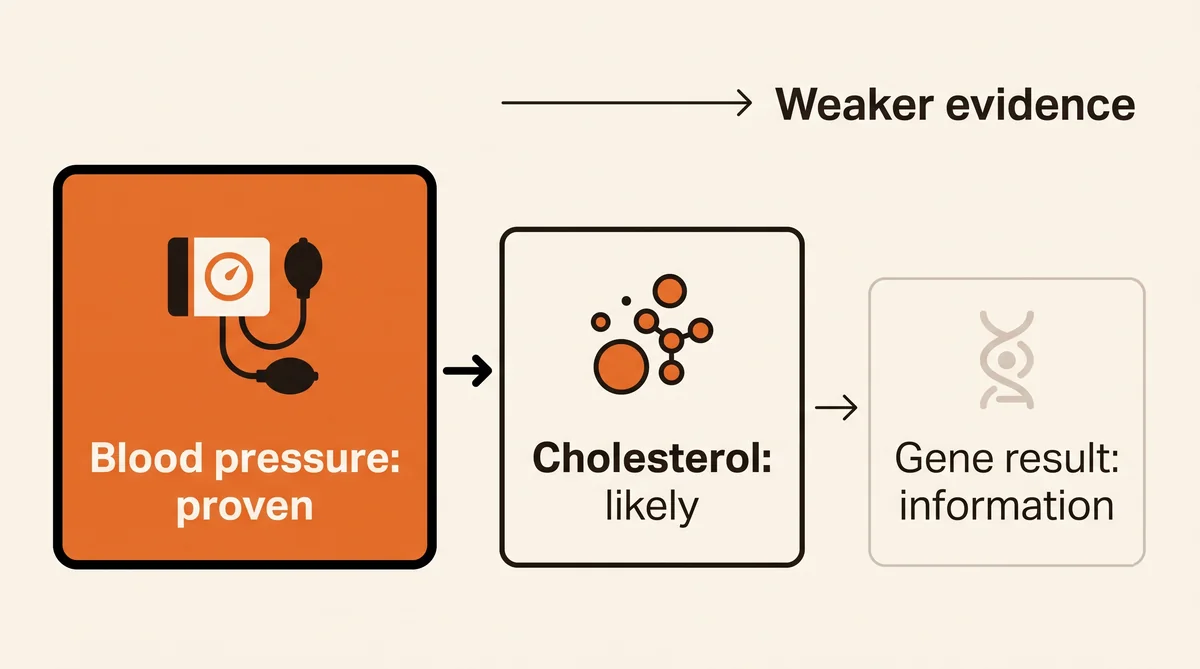
Control blood pressure. This is the strongest lever, and the only one with randomized trials showing a reduction in dementia itself. If nothing else changes after a visit, this is the change most likely to matter.
Treat cholesterol on its own merits, and count the brain as a plausible bonus. The reasons to lower LDL cholesterol in midlife stand on cardiovascular grounds alone. The genetic and epidemiological evidence that doing so also protects the brain is suggestive, points in the right direction, and does not require overstating. Lowering LDL will not harm the brain, which the old fear got backwards.
Read an APOE4 result for what it is. It raises risk; it does not determine outcome. Its most concrete current use is not as a verdict but as information: it identifies who benefits most from attention to the modifiable factors, and, for anyone considering the new anti-amyloid Alzheimer's drugs, it is already a treatment-planning variable, because ε4 carriers, and homozygotes especially, face a substantially higher rate of the drugs' main side effect.
Take the rest of the list seriously. The same 2024 Commission that added midlife cholesterol also names hearing, physical activity, smoking, alcohol, obesity, diabetes, depression, social contact, air quality, and vision. Together the modifiable factors account for a large share of dementia risk. None of these is a cardiology prescription, but a cardiologist who only adjusts a statin and stops there has answered a smaller question than the one the patient asked.
The most useful summary is also the simplest. The gene you cannot change turns out to work through channels you can influence, and the intervention with the best evidence is the one cardiology has always done. Worrying about dementia and doing something about your blood pressure are, more than the internet suggests, the same conversation.
Worried about dementia risk and want your heart numbers read by a cardiologist?
Book a Video Visit