

Cholesterol balance: production, absorption, and which drug should work
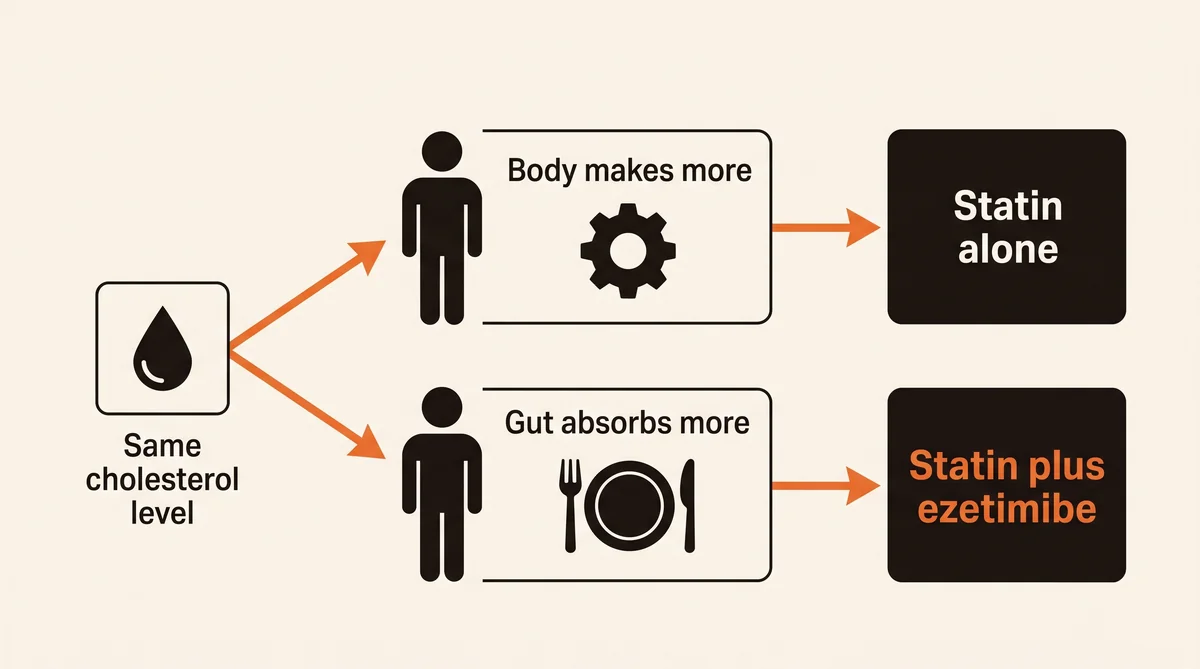
Somewhere in your lipid panel, past the numbers you recognize, there is a page with four compounds on it that nobody has ever explained to you. Lathosterol. Desmosterol. Campesterol. Beta-sitosterol. Underneath them is a single verdict, Over Producer, Balanced, or Over Absorber, and beside that a number called a Cholesterol Balance Score. Panels like this usually arrive from a functional medicine practice, a longevity program, or a direct-to-consumer testing company, and they are almost always handed over without an interpretation.
The verdict reads like a diagnosis. It is not one. It is a description of how your body arrives at the cholesterol level you already know about, and the interesting question is not whether the label sounds worrying but whether it changes anything you would do.
That question has an answer, and it is more useful than either the marketing or the dismissal. This panel is not a risk score, and reading it as one will either frighten you unnecessarily or reassure you falsely. What it plausibly does is tell you which of two very different drugs is more likely to work on you. The evidence for that has changed twice in the last twenty years, and the report in your hand does not mention it.
Reading the panel
Your body gets cholesterol two ways. It makes it, mostly in the liver, and it absorbs it from the gut.
The gut part is mostly not about food. A typical Western diet delivers 200 to 500 mg of cholesterol a day, but your own liver pours roughly 2 grams of cholesterol into the intestine daily in bile, several times more than you eat, and you absorb and retain something like 55 to 60 percent of what arrives there (reviewed in Patel and Thompson, Atherosclerosis 2006). The absorption machinery is largely recycling your own cholesterol. This is a good part of why dietary cholesterol turned out to matter less than a generation of advice assumed.
What the panel cannot tell you is how much of your cholesterol level comes from each route, because the two are coupled rather than additive. Suppress synthesis with a statin and absorption rises to compensate: in the PROSPER trial (Matthan and colleagues, J Lipid Res 2010), lathosterol fell by about half while campesterol rose by about 50 percent. Block absorption with ezetimibe and synthesis rises to meet it, which is why that drug lowers LDL cholesterol by roughly 20 percent rather than the far larger figure the absorption numbers might lead you to expect.
That coupling has a consequence: being an over-absorber does not, by itself, mean a higher cholesterol level. In the Finnish arm of the 4S trial, total cholesterol was essentially identical across all four quartiles of absorption phenotype (5.87, 5.99, 5.93 and 5.95 mmol/L). Among Old Order Amish carriers of a transporter variant that raises plant sterol levels by more than a third, LDL cholesterol was 148 mg/dL against 149 in non-carriers. The phenotype describes a route, not a destination.
You cannot see any of this on a standard lipid panel, and that is worth understanding, because it explains why this is a separate send-out test rather than a line on your usual report. A routine cholesterol assay detects a chemical feature, a double bond between two particular carbons plus a hydroxyl group, that plant sterols happen to share. Conventional methods therefore cannot tell the two apart. Distinguishing them requires gas chromatography or high-performance liquid chromatography, run on a different instrument. It matters little for your ordinary result, because plant sterols make up less than 1 percent of the sterols circulating in your blood. But it does mean that a number nobody has ever measured on you before is not necessarily a number anyone has established what to do with.
The panel reports three separate things, not two.
Production markers, lathosterol and desmosterol. These are intermediates on the pathway your liver uses to build cholesterol from scratch. If the assembly line is running fast, more half-finished product spills into the blood. High values mean you are synthesizing a lot.
Absorption markers, campesterol and beta-sitosterol. These are plant sterols. You do not make them; they come entirely from food, and your body actively works to keep them out. They are pumped back into the gut by a transporter pair called ABCG5/ABCG8 and preferentially excreted in bile, which is why so little accumulates. Because you cannot synthesize them, whatever fraction shows up in your blood is a readout of how efficiently your gut absorbs sterols generally, including cholesterol.
There is a fifth marker, cholestanol, and it is measured on every one of these panels. You have probably never seen it. Boston Heart counts it as a third absorption marker but does not report a normalized value for it, and prints the absolute concentration only when it exceeds 15.0 mg/L, a threshold set to catch a rare storage disease. So it is measured on your sample, categorized alongside the plant sterols, and then, in almost every case, left off your report.
The Balance Score sets the production markers against the absorption markers. Boston Heart's Test Code 509 bands it as follows:
| Over Absorber | Balanced | Over Producer |
|---|---|---|
| below 0.5 | 0.5 to 1.1 | above 1.1 |
with per-marker reference ranges of lathosterol below 85, desmosterol below 65, beta-sitosterol below 115 and campesterol below 170, each normalized to total cholesterol.
Two things about those bands. They are vendor thresholds, not treatment targets. No one has randomized anyone to move a Balance Score and counted heart attacks, and the question of what should be done at 0.4 versus 0.6 has never been tested. And the panel is describing a ratio. A score of 0.46 can mean high absorption, low production, or both, and those are not the same situation.
Where the idea came from
One trial, published in 1998.
The Scandinavian Simvastatin Survival Study (4S) (Miettinen and colleagues, BMJ 1998) randomized 4,444 patients with coronary heart disease to simvastatin or placebo. In the Finnish arm, investigators had stored blood from 868 patients and went back to ask a question nobody had asked before: does the way a patient handles cholesterol predict whether the drug works? Half received simvastatin 20 to 40 mg daily, half placebo, and they were followed for five years and three months.
The endpoint was 4S's secondary one, and it is worth spelling out because the composition matters: major coronary events, meaning coronary deaths, non-fatal heart attacks, and revascularization procedures (bypass surgery or stenting). That last component is softer than the other two. Whether a narrowed artery gets opened depends partly on the patient's biology and partly on a cardiologist's judgment, and judgment is more easily moved by knowing what a patient's cholesterol has done.
Across the whole Finnish group, simvastatin worked about as well as it did in the main trial: 144 events on placebo against 114 on the drug, a relative risk of 0.790 (95% CI 0.642 to 0.971).
Then they split the patients into four groups by a single pre-treatment measurement, cholestanol, one of the absorption markers, and the picture changed.
In the patients who absorbed the least cholesterol, simvastatin cut events by about 38 percent. In the patients who absorbed the most, the point estimate sat above 1, and the confidence interval ran from 0.791 to 1.720. That interval crosses 1 comfortably, so the statement to make is not that the drug harmed anyone. It is that a benefit could not be demonstrated in the group that absorbed the most.
This is the kind of finding that usually deserves suspicion. Split any trial four ways and something will look different. But two features make it harder to wave off. The investigators ran a formal test for interaction rather than eyeballing the subgroups, and it was significant (odds ratio 0.73, 95% CI 0.56 to 0.86, P<0.02). And of every baseline variable they examined, total cholesterol, LDL, HDL, triglycerides and body mass index, cholestanol was the only one that predicted who benefited.
The part the report does not tell you
There is a gap between that trial and the score on your page, and it is worth seeing clearly.
4S was built on cholestanol. Your Balance Score is not. Cholestanol is on your report, and Boston Heart labels it exactly as Miettinen did, a marker of cholesterol absorption. But it is reported as a lone absolute value with a single alert threshold, while the four markers that carry optimal and borderline ranges, and that generate the verdict at the top of the page, are lathosterol, desmosterol, campesterol and beta-sitosterol. The molecule the trial was about sits outside the number the report leads with.
The markers are related. In a companion paper (Miettinen and colleagues, ATVB 2000), baseline cholestanol correlated with campesterol at r = 0.589 and with sitosterol at r = 0.603. That is a relationship, and also a partial one: a correlation near 0.6 means the two markers share roughly a third of their variation. Cholestanol is a decent stand-in for the absorption axis, not a synonym for it.
And here the story gets stranger. Your laboratory still measures cholestanol; the trials stopped. The PROSPER substudy (Matthan and colleagues, J Lipid Res 2010), usually cited as the study that failed to confirm 4S, measured lathosterol, desmosterol, campesterol and sitosterol. The HIJ-PROPER trial measured sitosterol, campesterol and lathosterol. The Dallas Heart Study measured sitosterol and campesterol. None of them measured cholestanol. Every one substituted plant sterols for it, and the only published justification for that substitution is a pair of correlations near 0.6.
That has a consequence for PROSPER in particular. It is routinely cited as the study that failed to replicate 4S, but it did not measure the molecule 4S was about, on top of using a different statin, a much older population, and a different study design. It was never a replication attempt.
So the marker carrying the single positive randomized result is on your report but outside your score, and untested in every outcome study since. That is worth knowing before anyone tells you what your Balance Score means.
That same companion paper published the individual marker values for each of the four groups, in the same units your report uses. And Boston Heart, in its own physician guide, states exactly how it sorts patients: lathosterol determines your production status, and the higher of beta-sitosterol or campesterol determines your absorption status. Applying the company's own rule to the trial's own numbers, and then reading off the company's own treatment table:
| 4S group | Absorption | What Boston Heart recommends | What simvastatin did |
|---|---|---|---|
| Lowest absorption | optimal | "Statin therapy would be best" | 0.623 (0.395 to 0.982) |
| Second | borderline | "Statin therapy would be best" | 0.657 (0.426 to 0.998) |
| Third | borderline | "Statin therapy would be best" | 0.753 (0.502 to 1.130) |
| Highest absorption | high | "The combination of a statin and ezetimibe would be best" | 1.166 (0.791 to 1.720) |
The group Boston Heart would put on a statin alone is the group where a statin worked. The group Boston Heart would add ezetimibe to is the group where a statin alone did not demonstrably work. The company's recommendation and the trial's result line up, which counts in the test's favor and is worth saying plainly.
Two caveats. These measurements came from a Finnish research laboratory in the 1990s, not the instrument that ran your sample, and all four groups read "high production" against today's bands because everyone in the trial already had coronary disease. It is the absorption gradient across the four groups that carries the argument, not the absolute categories.
The table above works from the individual markers rather than the Balance Score itself, for a reason. The formula behind the score is not published. Neither the patient report nor the physician guide states how the score is computed, and working backward from a sample report, with production markers 91 and 51, absorption markers 385 and 260, and a printed score of 0.3, a straightforward production-over-absorption ratio gives 0.22. Several other plausible formulas do round to 0.3, and one sample cannot distinguish them. So the headline number on your page is generated by an undisclosed calculation. The underlying markers are printed, and those are what the table above uses.
Does being an over-absorber mean higher risk?
The answer, before the argument that supports it:
Yes, absorption affects risk, and the evidence for that is recent and strong. But most of that risk is already visible in the cholesterol number you have. For twenty years the literature said absorption phenotype carried no independent risk, and a 2020 genetic study of more than a hundred thousand coronary cases overturned it. What survived the overturning is the practical conclusion, not the reassurance: your Balance Score is still not a risk score, but for a subtler reason than anyone thought.
Four findings have to be reconciled, and they look irreconcilable at first.
The 4S placebo arm was flat. Among the 4S patients who got the drug, events climbed steadily across the absorption groups: 21, 23, 26 and 35 percent. Among patients who got placebo, they did not move at all: 33, 35, 35 and 30 percent. The investigators say it plainly: event rates were "unrelated to the ratios of cholestanol (or plant sterols) in the placebo group." Absorption predicted who benefited from a statin. It did not predict who had a heart attack.
The Dallas Heart Study found nothing (Wilund and colleagues, ATVB 2004). In 2,542 adults aged 30 to 65, coronary calcium was measured by CT and plasma sterols by mass spectrometry. Cholesterol separated the groups cleanly: 181 against 188 mg/dL in men, 178 against 196 in women. Plant sterols did not separate them at all, and the numbers ran slightly the wrong way for the risk hypothesis. Same null for family history of premature coronary disease.
The Amish carriers looked better, not worse (Horenstein and colleagues, ATVB 2013). Old Order Amish who carry a variant in the ABCG8 transporter have run 35 to 37 percent higher plant sterol levels their entire lives, since the variant arrived in Pennsylvania in the early 1700s. Their carotid artery walls were thinner than non-carriers' (0.62 against 0.66 mm), and the gap widened with age.
And then a study three hundred times larger said the opposite. In 2020, deCODE genetics (Helgadottir and colleagues, Eur Heart J 2020) examined variants in the same ABCG5 and ABCG8 genes across Iceland, Denmark and the UK Biobank: 105,490 people with coronary disease against 844,025 without. Variants that impair the transporter raise absorption of cholesterol and plant sterols alike. Scaled so the comparison is fair, per 1 mmol/L of genetically raised non-HDL cholesterol, those variants carried an odds ratio for coronary disease of 2.01 (95% CI 1.75 to 2.31), against 1.54 (1.49 to 1.59) for ordinary cholesterol-raising variants elsewhere in the genome. The difference was highly significant, and it held separately in all three countries.
How all four can be true
The resolution is that the studies measure two different things, and only one of them is trustworthy.
The first three measured the level of plant sterols in your blood. The fourth measured the genes that determine how much you absorb. That distinction does the work, because a blood level carries the company it keeps.
Look at what high plant sterol levels travel with. In Dallas Heart, they ran inversely with body mass index, fasting glucose, fasting insulin and triglycerides. In the Finnish 4S groups, the highest-absorption quarter was the leanest (body mass index 25.1 against 28.6), with the highest HDL and the lowest triglycerides. In the Amish, carriers had slightly lower Lp(a). Three independent populations, same pattern: the over-absorber phenotype travels with a metabolically favorable profile. Anyone comparing high-sterol people to low-sterol people is also comparing leaner people to heavier ones, and that comparison will hide a modest hazard or even invert it.
Genes do not have that problem. Which ABCG8 variant you inherited was settled before you were born and does not track your weight or your insulin. This is why the 2020 study is worth more than the three that preceded it, and it is the same reasoning that makes genetic evidence valuable throughout cardiology.
There is one more wrinkle, and it explains the Amish. Not every transporter variant does the same thing. The variants driving the deCODE result raise non-HDL cholesterol, which is precisely how the instrument is built. The Amish variant does not: those carriers had LDL cholesterol of 148 mg/dL against 149 in non-carriers. It raises plant sterols without raising cholesterol, which separates two exposures that usually move together. So the Amish study is not a smaller version of the deCODE study. It is a narrower question, asked of 291 people, using artery wall thickness rather than heart attacks.
And it explains the flat 4S placebo arm too. To enter 4S you had to have a total cholesterol between 5.5 and 8.0 mmol/L. The trial selected on the very thing through which absorption carries most of its risk. Hold cholesterol roughly constant by design and the residual signal from absorption phenotype is small, which is exactly what they found.
What this leaves you with
The deCODE investigators split their own result. About 62 percent of the excess coronary risk from these variants runs through non-HDL cholesterol. Roughly 38 percent does not, and they attribute the remainder to plant sterols themselves.
That first number is the one that matters for reading your report. Most of the risk that comes with absorbing cholesterol efficiently shows up as a higher cholesterol level, which your ordinary lipid panel has been measuring all along. The sterol panel is not adding a hidden danger on top of what you already knew. It is explaining the mechanism behind a number you already have.
Which brings back the through-line: the phenotype describes a route, not a destination. If your cholesterol is high, being an over-absorber tells you something about why. If your cholesterol is fine, the panel has not found a secret problem.
What about the other 38 percent?
The remainder deserves a moment, because it is the one place where plant sterols might be doing something to you directly rather than through your cholesterol level, and because it decides a practical question later on.
The deCODE investigators are careful about it. They found excess risk that their cholesterol measurements do not account for, and they nominate plant sterols as the likely culprit, reasonably, since those are the other thing these transporter variants change. But notice the shape of that argument. They measured a residual and named a candidate to fill it. That is a hypothesis, and a sensible one, not a demonstration.
The human evidence bearing on the candidate is thin and points the other way. In Dallas Heart, plant sterol levels did not track coronary calcium in 2,542 people. In the Amish, carriers with lifelong elevations had slightly thinner carotid walls. A third study, by Silbernagel, found no association with coronary disease (reported in Horenstein and colleagues). Set against those, as catalogued in Patel and Thompson: a study of 595 patients with high cholesterol found phytosterols associated with premature coronary disease, and a study of 53 patients awaiting bypass surgery found higher sterol levels in those with a family history. Those last three are as the reviews report them, not read directly. The larger and less selected the study, the more consistently it finds nothing.
But every one of those studies measured a level, and we have already seen what levels drag along with them. So the position to hold is not that plant sterols have been exonerated. It is that nobody has yet asked the question in a way that could answer it. Genetics established that absorption matters; nothing has established which molecule is responsible for the part that cholesterol does not explain.
That unresolved question has a practical edge, because the supplement aisle sells products that raise exactly the compounds under suspicion.
Does it tell you which drug to use?
This is the claim the test is actually sold on, and it is the one worth taking seriously.
There are two drugs. A statin blocks production. Ezetimibe blocks absorption. If a panel could tell you which pathway is driving your cholesterol, it ought to tell you which drug will move it. That is a reasonable hypothesis, and unusually, it has been tested from both directions.
From the production side, 4S: patients who absorbed the least got the most from a statin, and patients who absorbed the most could not be shown to benefit.
From the absorption side, a Japanese trial called HIJ-PROPER (Hagiwara and colleagues, Eur Heart J 2017) asked the mirror question. It randomized 1,734 patients who had just had a heart attack or unstable angina to a statin alone or a statin plus ezetimibe, and followed them a median of 3.86 years. Sitosterol was measured before treatment, and it was a predetermined variable, specified in advance rather than dredged from the data afterward.
The trial as a whole was negative. Adding ezetimibe did not reduce the primary endpoint: 32.8 percent against 36.9 percent, hazard ratio 0.89 (95% CI 0.76 to 1.04, P = 0.152). But split by pre-treatment sitosterol at its median of 2.2 µg/mL:
| Statin alone | Statin plus ezetimibe | Hazard ratio | |
|---|---|---|---|
| Above median absorption | 156 of 416 (37.5%) | 111 of 399 (27.8%) | 0.71 (0.56 to 0.91) |
| Below median absorption | 142 of 398 (35.7%) | 157 of 411 (38.2%) | 1.11 (0.88 to 1.39) |
Test for interaction, P = 0.010.
Put that in absolute terms, which is what actually matters to you. In the half of patients who absorbed more, adding ezetimibe prevented an event in about 1 in 10 people treated over roughly four years. In the half who absorbed less, it prevented nothing. The numbers ran slightly the wrong way, though not significantly, so the fair description is "no benefit" rather than "harm."
Two trials, twenty years apart, different countries, different drugs, different marker molecules, pointing the same direction. That convergence is the strongest thing this test has going for it.
Now the reasons to hold it loosely, because they are substantial.
The overall trial was negative, and this is a subgroup within it. Seven or eight subgroups were examined and two came out significant: sitosterol and, separately, whether the patient had high blood pressure. At conventional thresholds you would expect roughly half a false positive among that many comparisons; getting two is more than chance, but not by a comfortable margin. Campesterol, the other absorption marker, pointed the same way but missed significance (P = 0.094). The trial was open-label, and a third of its primary endpoint was revascularization, a decision made by physicians who knew which arm the patient was in. It enrolled Japanese patients with acute coronary syndrome, screening 8,538 to find 1,734. And the authors close with the sentence that governs all of it: further confirmation is needed.
One coherence check does favor the finding. Lathosterol, the production marker, predicted nothing (P = 0.299). If the sitosterol result were noise, you would not expect the noise to land specifically on the axis that matches the drug's mechanism.
The trial that would settle it has not been run
Boston Heart's physician guide carries a callout stating that "IMPROVE-IT data highlight cholesterol absorption as an important pathway for the treatment of CVD patients."
IMPROVE-IT is the large trial that established ezetimibe adds benefit on top of a statin. It is excellent evidence for the drug. But IMPROVE-IT never measured sterols, and never identified anyone as an absorber. It shows that ezetimibe helps; it says nothing about whom this panel should select. We know the analysis was never done because in 2022 a group of specialists published a letter in a cardiology journal (Makhmudova and colleagues, JACC 2022) asking for exactly that: measure plant sterols in the stored IMPROVE-IT samples and find out who benefited most. As of that letter, nobody had.
Summarized: a prespecified randomized interaction pointing the right way, echoing a twenty-year-old finding from the opposite direction, inside a trial that was otherwise negative, with the confirmatory study still unrun.
If you are already taking a statin, this panel is measuring your drug
No report I have seen mentions this, and it changes how your result should be read.
Statins block production. Your body compensates by absorbing more. The effect is not subtle: in the PROSPER trial (Matthan and colleagues, J Lipid Res 2010), five years of pravastatin cut lathosterol, the main production marker, by about half, while campesterol, an absorption marker, rose by about half. Both directions, in the same patients, from one drug.
So a Cholesterol Balance panel drawn while you are on a statin does not show your natural phenotype. It shows your phenotype plus your treatment, shifted toward the absorber end of the scale by the medication itself. Someone who was balanced before treatment can look like an over-absorber on therapy, and the report will recommend the very drug that finding implies.
That is not a reason to distrust the number. It is a reason to know what the number is answering. If the question is "should I add ezetimibe to the statin I am already taking," then measuring on-treatment absorption is arguably the right measurement, because it describes the situation you are actually in. If the question is "what kind of cholesterol metabolism do I have," the answer requires a sample drawn before the statin started, which for most people is a sample nobody took.
Worth asking your physician which question your test was answering.
The supplement aisle
Plant sterols and stanols are sold in margarines, yogurt drinks and capsules on the strength of a measurable effect. They work by displacing cholesterol from the mixed micelles in your gut, so less is available to absorb.
The magnitude is well established. A consensus review pooling 41 trials (Katan and colleagues, Mayo Clin Proc 2003) found that 2 grams a day lowers LDL cholesterol by about 10 percent, with a pooled estimate of 10.1 percent and a 95 percent confidence interval of 8.9 to 11.3. Around half that effect arrives at 0.7 to 1.1 grams. Above roughly 2.5 grams there is little further benefit, with a ceiling estimated at 11.3 percent. Combined with a diet low in saturated fat, the review puts the achievable reduction near 20 percent, and it notes that adding sterols to a statin lowers LDL more than doubling the statin dose.
You cannot get there by eating well. A Western diet already supplies 200 to 400 mg of plant sterols daily, against the 2 grams needed for the 10 percent effect. That is a five- to tenfold gap, and no ordinary pattern of vegetables, nuts and oils closes it. This is a supplement question, not a diet question, and anyone telling you to eat more plant sterols is describing an intervention you cannot reach through food.
Then the complication. These products work by raising the very compounds the deCODE study put under suspicion. Regulators have looked at the same evidence and disagreed (reviewed in Köhler and colleagues, Br J Pharmacol 2017):
| Position | Who |
|---|---|
| Recommend as a dietary option | European Atherosclerosis Society; National Heart Foundation of Australia |
| Advise against general recommendation, citing absent endpoint data | NICE (United Kingdom); German Drug Commission |
Even the guidelines that endorse them conclude that long-term studies are needed to guarantee their safety. And there has never been a trial of plant sterol supplements with heart attacks as the endpoint. Every number above is an LDL number.
There is one detail that captures the uncertainty better than any hedge. Plant stanols are the saturated version of plant sterols, and they are absorbed far less: roughly 0.02 to 0.3 percent of intake, against 0.4 to 5 percent for sterols, giving blood concentrations about ten times lower. They lower LDL just as effectively. When the Finnish company Raisio developed the first stanol margarine, it chose to chemically saturate the sterols into stanols before bringing the product to market, specifically because plant sterols were suspected of pro-atherogenic effects, an extra manufacturing step that made the product more complex and more expensive. A company paid more to avoid a hypothetical risk. That tells you something about how open the question was, and remains.
Where that leaves a practical decision. If you want this lever, take stanols rather than sterols. They deliver the same LDL reduction while raising circulating plant sterols roughly tenfold less, so the choice holds up whichever way the safety question eventually resolves. It is the rare situation where the uncertainty itself points to a specific product.
How to proceed
"Discuss with your doctor" is not a plan. Here is one.
If your LDL cholesterol is at goal, this panel changes nothing. Nothing in the evidence supports treating a Balance Score as a target in its own right. No one has randomized anyone to move a Balance Score and counted events, the bands are vendor conventions that have already been revised at least once, and the risk that comes with absorbing efficiently is largely the risk of the cholesterol number you already have. If that number is where you want it, the panel is interesting rather than actionable.
If you are not at goal on a statin, this is the question the test can help with. The evidence supports one specific use: deciding whether to add ezetimibe rather than push the statin dose higher. If your absorption markers are high, that decision has a prespecified randomized interaction behind it and an absolute benefit in the range of 1 in 10 over four years, in patients who had already had a heart attack. If your absorption markers are low, the same evidence says added ezetimibe is unlikely to do much, and the conversation should be about statin intensity, adherence, or a different mechanism entirely.
If you have not started treatment, get the panel before you do. It is the only way to see your untreated phenotype, and it costs nothing extra to draw it in the right order.
The ceiling. Do not chase the markers themselves. Treat LDL cholesterol, or non-HDL cholesterol, or apolipoprotein B, the measurements with outcome trials behind them, and let the sterol panel inform how you get there. If a plan involves repeatedly re-drawing sterols to watch a Balance Score improve, it has crossed from evidence into numerology.
One exception that matters. A markedly elevated beta-sitosterol or campesterol, far above the reference range rather than modestly over it, is worth a second look. Phytosterolemia is rare, with a reported frequency near one in five million and a true prevalence nobody knows, but it responds dramatically to ezetimibe and poorly to statins, and it is routinely missed for years. The gap between "high absorber" and that disease is more than tenfold in circulating sterol fraction, so a borderline-high result is not a hint of it. A dramatic one deserves a conversation.
Want your Cholesterol Balance panel read by a cardiologist?
Book a Video Visit